
Subconscious Patterns
Fixed Roles and Limiting Beliefs: How to Change Your Story
By Aurelija Aspen, Founder of the Energetic Reprogramming Method™ | August 12, 2026
What if “That’s just who I am” isn’t actually who you are?
What if some of the things you believe about yourself are not simply beliefs, but roles you have become deeply accustomed to living out?
Through my work with clients, I began noticing a recurring pattern: as limiting programs were uncovered and released, specific identity formulations would often emerge:
The one who is… The one who has to… The one who cannot… The one who always…
I began calling these fixed roles.
They can feel so deeply embedded that a person no longer experiences them as a role at all. They can feel like who they are.
And when a role becomes deeply fixed, it can influence what we believe we can do, how we relate to others, the choices we make, and what we believe our life is supposed to look like.
The question then becomes:
What do you really choose? What do you want your identity to be? How do you want to see yourself?
What Is a Fixed Role?
“Fixed role” is terminology developed within the Energetic Reprogramming Method™ to describe the embedded identity pattern that usually surfaces during the release of limiting programs. It is not intended as a clinical diagnosis or psychological disorder.
I see these patterns as subconscious and energetic layers of experience.
They often appear in a surprisingly simple form:
The one who is not good enough. The one who cannot let go. The one who has to control everything.
The words themselves may sound ordinary.
What makes the role significant is the fixation underneath it. It is like playing the same old story over and over again.
When a fixed role emerges during a session, the fixation on it is released with the client’s permission.

A fixed role doesn’t always feel like a cage. We can grow so used to the shape that it starts to feel like home.
How Do Fixed Roles Develop?
Fixed roles can develop in different ways.
1. Internalised roles
You experience something, draw a conclusion about yourself or the world, and carry that conclusion forward.
2. Projected roles
Projected roles are typically embedded in childhood. Parents, teachers, or other people may decide things about us, or decide who they think we are supposed to be, and we then internalise those descriptions.
3. Inherited or infused roles
Some patterns may also be connected with family, culture, or what we have absorbed from the environment in which we grew up or from the people we spent time with.
Whatever the origin, an important question remains:
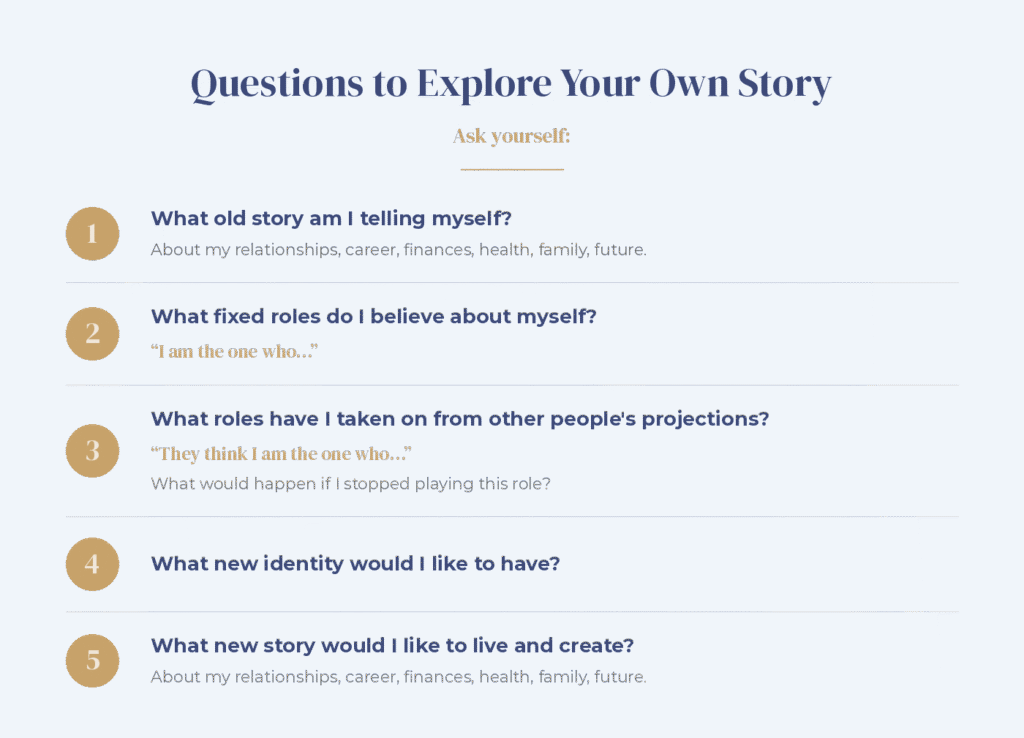
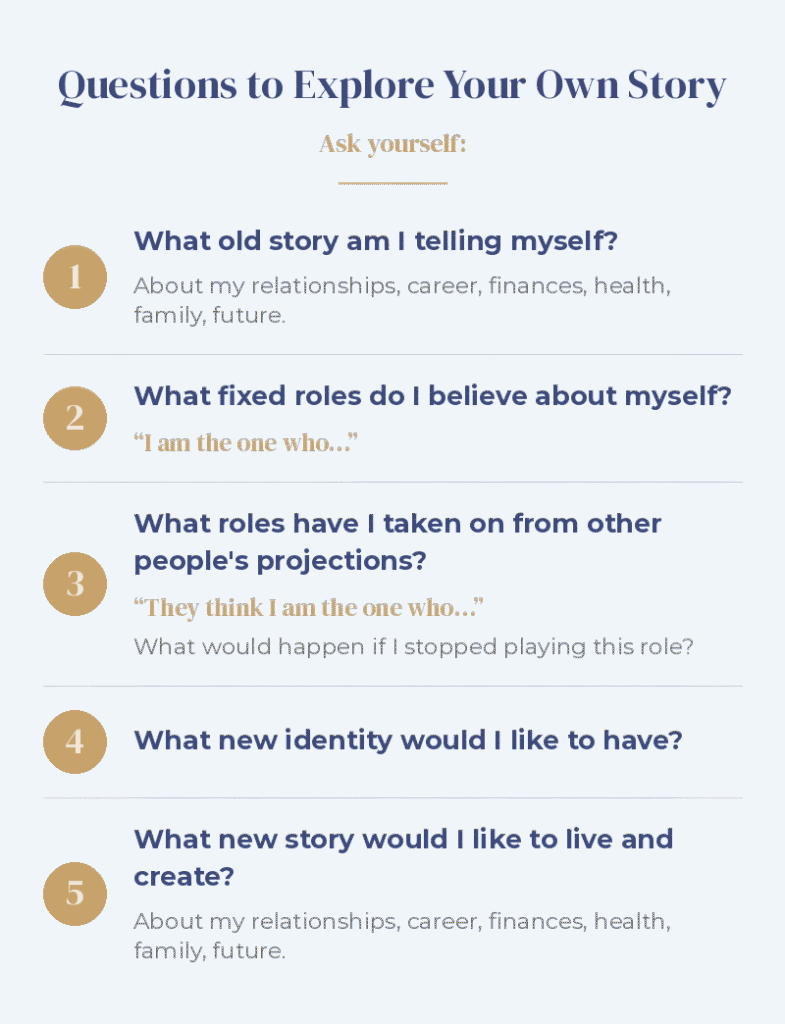
Is this still something I consciously choose to be or believe I am?
Type
How it forms
Example
Internalised
You draw a conclusion from your own experience
“The one who is a failure”
Projected
Others decide who you are, and you internalise that
“The one who is too weak”
Inherited, infused
Absorbed from family, culture, or environment
“The one who has to be silent”
Fixed Roles and Limiting Beliefs: What's the Difference?
The two are closely connected, but I use the terms differently.
A limiting belief is a belief that restricts what you perceive as possible. For example:
I am not capable enough. I don’t belong here.
A fixed role goes a level deeper. It usually sits underneath a limiting belief, and together with the limiting program, holds that belief in place. It may sound like:
The one who is not capable enough. The one who doesn’t belong.
The distinction isn’t always something a person consciously understands before a session. In my work, these layers often reveal themselves through the process itself.
How the Energetic Reprogramming Method™ Works With Fixed Roles
The Energetic Reprogramming Method™ is the approach developed through my own personal transformation, years of study, and thousands of sessions with clients. Within this framework, limiting programs and deeply embedded patterns are explored as they arise during a session.
When a person comes to me with an issue, we begin with what is presenting itself.
Within the Method, limiting programs are identified one at a time using muscle testing, and worked with.
Then a fixed role may emerge. For example: The one who has to take care of everyone.
We work with that pattern. Then another layer may appear: The one who cannot relax.
And another: The one who has to be there for everyone.
Each layer is worked with and, with the client’s permission, released.
The process can continue in layers, and it is common for the energy holding multiple roles in place to be released within a single session.
The intention is not to force a particular outcome.
It is to allow the layers that present themselves to be seen, acknowledged and transformed, one by one.
A Client Story: From “Everything Is Already Decided” to “I Can Choose”
One client came to a session carrying a heavy sense of disappointment and emptiness.
She described a kind of fog around her, a feeling that nothing new could really happen in her life anymore, as though everything had already been decided.
Underneath that experience were patterns around love, worry, responsibility, and a felt need to take care of everything around her before she could allow herself to rest.
As we worked through the limiting programs within this pattern, different fixed roles began to emerge:
The one who has to take care of everything before she can rest.
The one who doesn’t know how to choose for herself.
The one who makes mistakes.
The one whose choices don’t lead anywhere good.
Each time a pattern emerged, we worked with it and, with her permission, released it.

A woman came to a session carrying a heavy sense of disappointment and emptiness.
What Changed During the Session?
The client used a 0 to 10 scale to describe how strongly she experienced certain patterns before and after the session, where 0 meant neutral and 10 meant a very strong, intense sense, feeling, or belief.
These numbers represent her subjective experience, not clinical measurements or objective measures of treatment effectiveness. Their purpose was simply to help her notice how strongly each pattern was present.
Her sense of disappointment, emptiness and loneliness moved from:
7/10 → 2/10
Her sense of meaninglessness, the feeling that nothing new could happen anymore, moved from:
7/10 → 0/10
And her belief that love itself could hurt, harm or take things away moved from:
9/10 → 1-2/10
But the numbers were not the only change.
From the Old Story to a New Story
As her emotional and mental state shifted, the story she had been telling herself began to change too. The old story was essentially:
I cannot choose for myself. Everything is already decided. My choices don’t lead anywhere good.
A new possibility began to emerge:
I am creating my own life. I make my own choices. I choose to show up for myself with love and kindness.
One of the new statements that emerged from the work was:
“I choose to create a new, exciting story, one that holds love, trust, light and purpose.”
This illustrates something important about changing a fixed role:
Letting go of a role does not necessarily mean letting go of what matters to you.
You can still love. You can still care. You can still support. You can still be responsible.
But perhaps you no longer have to carry the identity that says you must.
What Happens When a Fixed Role Is Released?
A fixed role can be so deeply connected to a person’s identity that releasing it can create an unexpected question:
Who am I without this role?
Imagine someone who has spent decades being: the strong one; the one who never needs anything. If those roles begin to disappear, freedom can initially feel unfamiliar. There may be nothing wrong with the person they were before. They are simply no longer required to carry the same identity.
This is why, at the end of my work, I use energetic download to teach clients how it feels to experience life without these roles.
The work is not only about releasing what no longer serves them. It is also about becoming familiar with: Who am I when I don’t have to be that person?
Frequently Asked Questions
What are examples of fixed roles?
Examples include:
The one who is dependent. The one who doesn’t move forward. The one who always worries. The one who either holds on tightly or pushes away. The one who lets others decide.
Can a positive quality become a fixed role?
Yes. Caring, responsibility, patience and strength can all be positive qualities.
They can become limiting when a person feels they must always embody them and cannot freely choose otherwise.
Can fixed roles develop in childhood?
Yes. Roles may develop from childhood experiences, family expectations, relationships, cultural influences or conclusions a person makes about themselves.
How do I know if I am living inside a fixed role?
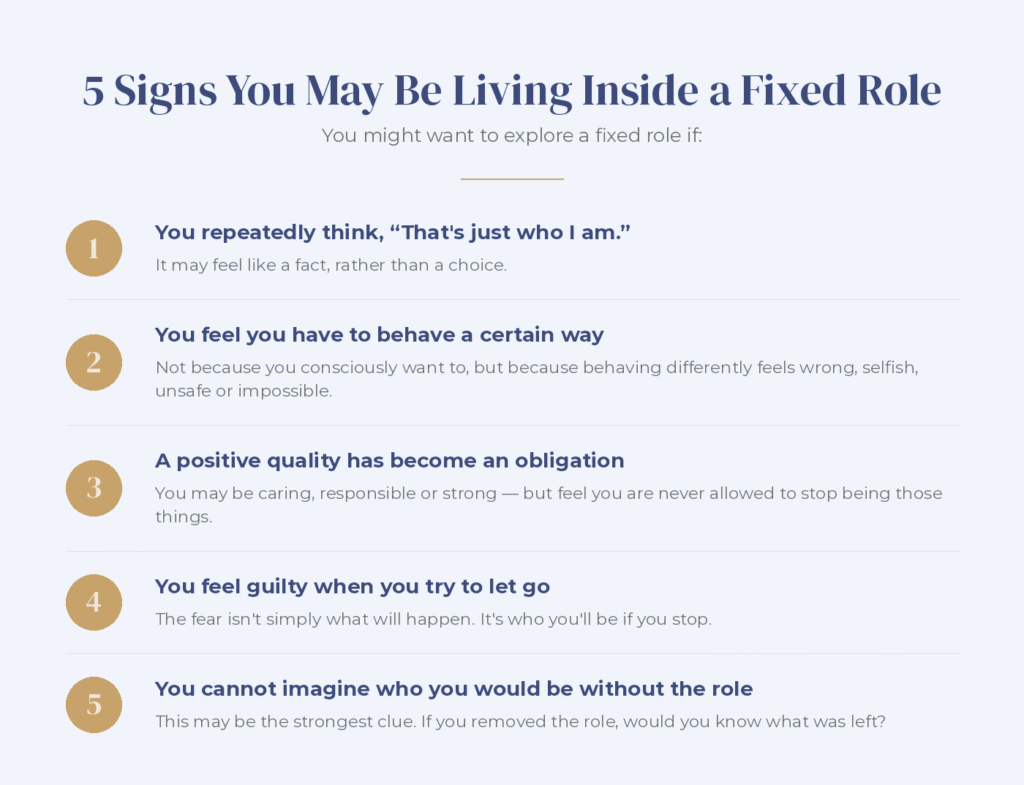
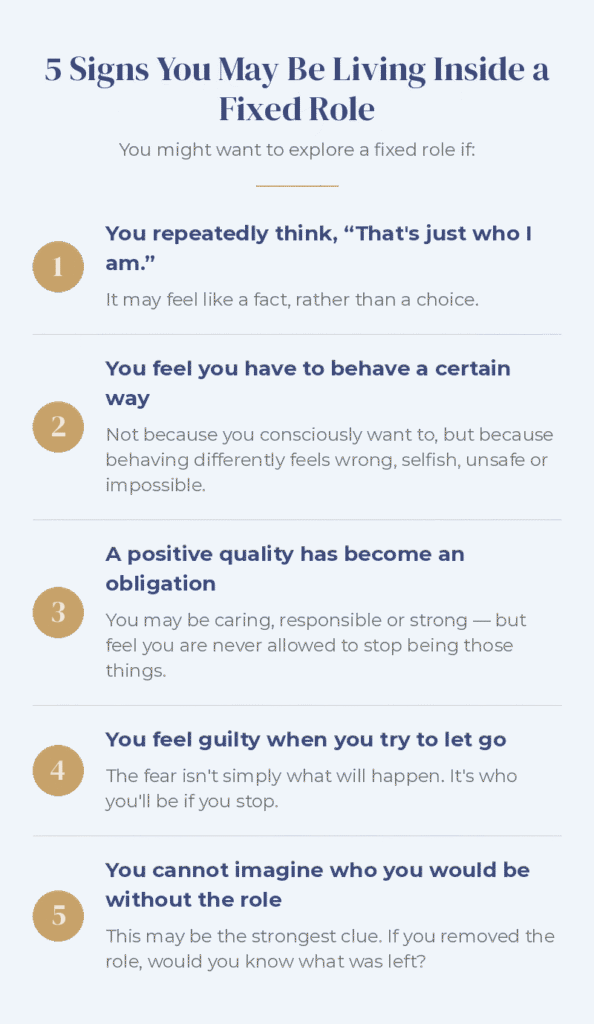
A few signs can point to it. You might notice yourself thinking “that’s just who I am,” as though it was a fact rather than a choice. You may feel you have to behave a certain way, not because you want to, but because anything different feels wrong, selfish or unsafe. A positive quality, like being caring or strong, may have quietly become an obligation you’re never allowed to stop. You might feel guilty when you try to let go, less afraid of what will happen than of who you’d be if you stopped. And if you can’t quite imagine who you’d be without the role, that alone can be the clearest sign of all.
Can fixed roles be released?
Yes. What is actually released is the fixation on the role, along with the energy connected to it, such as the negative emotions held in that pattern. As this happens, with the client’s permission, the energy shifts.
What happens after a fixed role is released?
Once the roles have been released, an important part of the process is turning toward what you actually want: what new identity you want to embody, and what you truly want to feel.
Ready to Change the Story Beneath Your Patterns?
If you recognise yourself in one of these roles, you may be curious about what is underneath the pattern, and what life might feel like without having to carry it.