
EMOTIONAL HEALING
How to Forgive: The Practice That Reaches Deeper Than Willpower
By Aurelija Aspen | May 2, 2026
You may have already tried. You decided to let it go. You told yourself it was in the past. Maybe you even said the words out loud, “I forgive you,” and yet something remained. A tightness in the chest. A flash of anger when their name comes up. A quiet, persistent weight that follows you into new situations, new relationships, new beginnings.
If this sounds familiar, you are not failing at forgiveness. You are simply discovering that even though the decision to forgive starts in the mind, the mind alone cannot complete it. True forgiveness has to happen at a deeper level: in the body, in the subconscious, and in the energetic field.
And when it does happen at that level, something remarkable becomes possible. You return to yourself. To your lightness. To a life that feels open, free, and genuinely your own.
What Forgiveness Actually Is, and What It Is Not
Forgiveness is one of the most misunderstood concepts in everyday life and in widely held beliefs. So before we talk about how to do it, it helps to be clear about what it actually is.
Forgiveness is not pretending that what happened was acceptable. It is not allowing the same harm to happen again. It is not reconciling with the person who hurt you, and it is not forgetting what happened.
Forgiveness is reclaiming the energy you have been using to maintain the pain. It is making peace with the past, not for their sake, but for yours. It is choosing your own inner freedom over holding onto what was done.
Forgiveness is, at its core, an act of self-love.
Why We Hold On to Resentment (and Why Forgiveness Is Not Reconciliation)
There is also what we might call a secondary gain at work. By staying angry, you may feel a sense of moral clarity, or a quiet sense of power, a sense of being right, of being the one who was wronged. It feels safer to be angry than to be vulnerable. But armour is heavy. Over time, that protective pattern begins to cost more than it protects. It leaks into new relationships. It creates a ceiling on what feels possible. It keeps you oriented toward the past rather than open to the present.

Resentment keeps us oriented toward the past rather than open to the present.
Forgiveness happens entirely within you. It does not require the other person’s presence, participation, or awareness. What you are releasing is not the relationship. When you choose to forgive, you are releasing the energetic charge, the loop of pain, anger, or injustice that continues to run in the background of your life, consuming your energy long after the event itself has ended.
The Myth of Forgive and Forget
Have you noticed that years go by and you still think about the same person, about the same situation over and over again, as if you are caught in the same loop? This is not a flaw. It is a protective function. But it drains your energy and persistently asks for your attention.
The goal of forgiveness is not to erase the memory. It is to transform it, so it loses its grip on you. When true forgiveness happens, the memory remains, but its charge changes. What was once a live emotional trigger becomes neutral information. You can recall what happened without being pulled back into the pain of it. The event becomes part of your story without continuing to write your present. That is the freedom forgiveness brings.
Addressing the Objection: They Do Not Deserve It
This is the most common resistance to forgiveness, and it is completely understandable. Why should you forgive someone who has never acknowledged the harm they caused? Why release the anger when they are not sorry? Forgiveness does not give the other person anything. It gives you something truly precious: your own power back.
Holding onto resentment does not punish the person who hurt you. In most cases, they are living their life without awareness of the weight you are carrying on their behalf. The anger lives in you, not in them.
Choosing to forgive is not saying that what they did was acceptable. It is saying, I am no longer willing to let what happened to me in the past determine how I feel in the present. I am much more than what has happened to me. I choose to be happy. That is not weakness. That is one of the most powerful choices a person can make.

Everyone is allowed to be free from resentment.
Why Willpower Is Not Enough
If you have ever tried to force yourself to forgive, deciding to just move on, you already know that willpower alone does not work. This is because resentment does not live only in the mind. It lives in the body. It lives in the subconscious. It lives in the energetic patterns we carry, often without being fully aware of them.
The mind can decide. But the body keeps its own record. This is why people who have done significant inner work, therapy, journalling, meditation, and personal development can still find certain resentments stubbornly in place. It is not because they have not worked hard enough. It is because the tools they have been using work at the level of the conscious mind, while the resentment is held somewhere deeper.
Standard affirmations often fall into the same limitation. Repeating “I am at peace” while your chest is tight just indicates that there is something deeper. The words reach the mind. The body is not listening. True forgiveness requires reaching that deeper level. And sometimes, the most effective way to do it is through deep inner work and facing the truth. If you feel that you do not have the right tools to reach that depth on your own, I am here to support you. You can explore what to expect in your first energy healing session or schedule a discovery call.
The Role of the Body
Your body does not distinguish between a memory and a present threat. When you recall a painful experience, a betrayal, a humiliation, a moment of deep hurt, your body responds as though it is happening now. Something tightens. Your breath shortens. You feel the familiar pull back into that old story. This is why you cannot think your way into forgiveness. You can understand intellectually that you should let go, and yet the body holds on.
Real forgiveness work reaches the body, the energetic field, and the subconscious layer where the pain has been stored. When that layer receives the signal that the threat has passed, that you are safe, that you are free, something in you genuinely softens. And that softening is the beginning of coming home to yourself. And the best part is that your relationship with yourself significantly improves. Your body, mind, and heart begin to trust you again because you show that you care and are willing to listen to them with genuine attention and love.
The Willingness to Forgive Is Already Something
Forgiveness does not have to arrive fully formed. The willingness to forgive is as powerful as forgiveness itself.
If you cannot yet say “I forgive you” and mean it, you can say: “I do not know how to forgive this yet. But I am willing to.”
That willingness, sincere and honest, is already a shift. It signals to the deeper self that you are open to release. And from that opening, the process can begin.
The Forgiveness Formula: How It Came to Be
I allow myself to completely forgive ___ for ___.
I am allowed to completely forgive ___ for ___.
I choose to completely forgive ___ for ___.
I completely forgive ___ for ___.
The Forgiveness Formula workbook
The Two Steps That Actually Work
The second step is the affirmation practice. Once you have acknowledged what happened, you move into the structured sequence, designed not to bypass your feelings, but to meet them and move through them. The affirmations work at the level of permission and energy, not just thought. They do not ask you to pretend. They do not demand feelings you do not yet have. They begin where you actually are, and they carry you forward.
At the end of the practice, you are invited to make one conscious choice, a declaration of how you want to feel now that the weight has been released. For example:
I choose to be in my power.
I choose to be happy.
I choose to be free.
This final choice seals the practice with a new, forward-facing intention.
What Life Feels Like After
You may also notice it in your body. The tightness softens. The breath deepens. There is a physical sense of having set something down.
Forgiveness does not change the past. But it changes your relationship to it, and in doing so, it changes what becomes possible going forward.
Signs That True Forgiveness Has Happened
You will know when genuine forgiveness has occurred not because you have declared it, but because you feel it.
- The memory of what happened no longer pulls you out of the present.
- You can think of the person without the familiar heat of anger or the ache of hurt.
- You can think of the person without wanting them to see your pain or change their behaviour.
- You feel a quiet neutrality, not indifference, not approval, but peace.
- More energy is available to you in daily life.
- You make choices from your own values rather than as a reaction to old pain.
This is what inner freedom actually feels like. Not the absence of memory. The absence of charge.
Your Structured Practice for Forgiveness
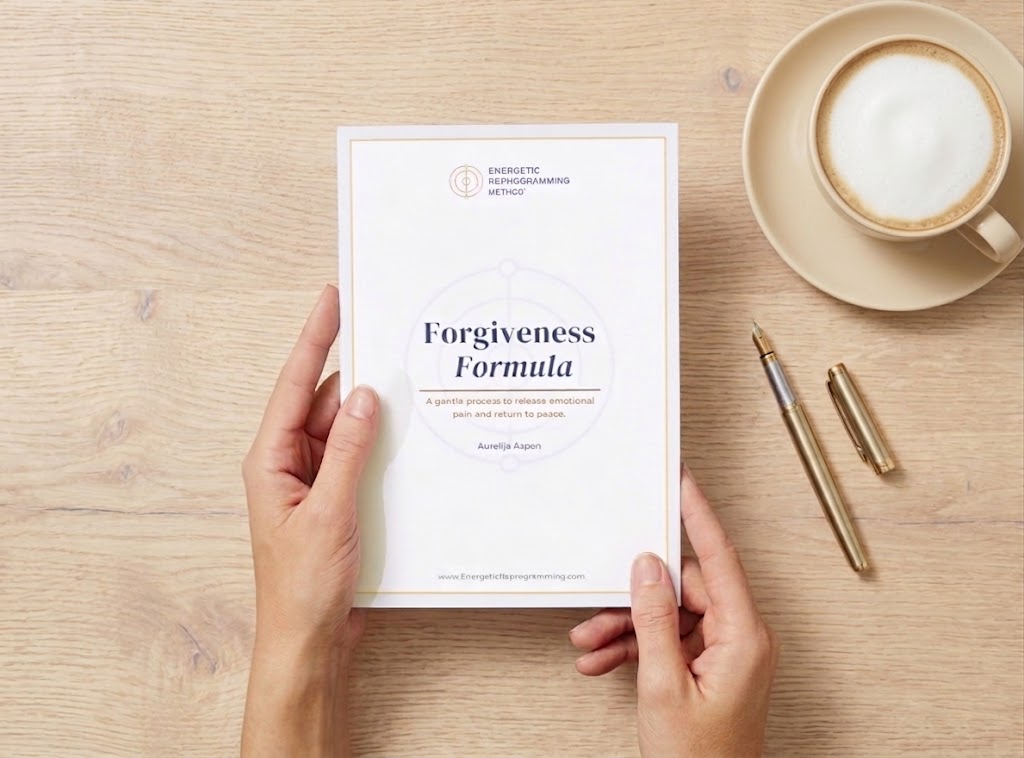
If you feel ready to try a structured practice for this work, I have created a step-by-step workbook: the Forgiveness Formula. It includes the full acknowledgment process and the affirmation sequence, with worked examples for self-forgiveness and forgiving others. It also includes 7 signs that forgiveness is complete and 9 questions to help you know when you have truly arrived.
Forgiveness is one of the most powerful acts of self-love available to us. It is how we return to our own purity of heart. It is how we remember who we truly are beneath the weight of old pain. And it is how we open ourselves, genuinely and fully, to a life that is blissful, abundant, and free.
Lightness and clarity are your natural state. Forgiveness is simply the path back to them. We are all learning to master the art of forgiveness.
Frequently Asked Questions About Forgiveness
Is forgiveness the same as condoning what happened?
No. Forgiveness does not mean saying that what was done was acceptable. It means choosing to release your own internal charge around it. You can forgive completely and still hold clear boundaries, still know that what happened was wrong.
How do I forgive someone who is not sorry?
Forgiveness does not require the other person’s participation. It happens within you, independently of whether they have apologised, changed, or even acknowledged what they did. You are not releasing them. You are releasing yourself.
Can I forgive myself for past mistakes?
Yes, and self-forgiveness is often the most important work. We tend to hold ourselves to a standard we would never apply to others. The same acknowledgement and release process applies. You acted with the awareness and tools available to you at the time. That version of you deserves the same compassion you might extend to someone else.
What if the anger comes back after I have forgiven?
Recurring anger is not a sign that the forgiveness failed. It is a sign that there is another layer ready to be addressed. Forgiveness can be layered. Each time the feeling resurfaces, there is an invitation to go a little deeper. Return to the practice whenever you need to.
What if I do not feel ready to forgive?
Then you do not have to. Forgiveness cannot be forced. But you can begin with willingness, with the honest acknowledgement that part of you would like to be free from this, even if you do not yet know how. That willingness is enough to start.
Can I forgive someone who is no longer in my life?
Absolutely. Because forgiveness happens within you, it does not require the other person’s presence. You can forgive someone who has passed away, someone you have lost contact with, or someone you never wish to see again. The work is entirely internal.