
SELF-HEALING PRACTICES
5 Daily Practices to Support Your Emotional Wellbeing
You can spend your whole life trying to change external circumstances—and still not feel better. Or you can learn how to support yourself from within.
By Aurelija Aspen | March 30, 2026
We spend 24 hours a day, 7 days a week with ourselves. And yet, many of us underestimate how much influence we have over our inner world, our mindset, and our emotional wellbeing.
You already have the power to regulate your emotions, shift your state, and create a more grounded, peaceful inner experience.
Here are five simple, powerful daily practices for emotional wellbeing that will help you reconnect with yourself and feel more aligned from within.
What are simple ways to improve emotional wellbeing?
Improving your emotional wellbeing doesn’t have to be complicated. Simple daily practices like writing down your emotions, accepting your feelings, practising self-love, increasing emotional awareness, and setting clear intentions can help you feel calmer, more balanced, and more connected to yourself.
1. Write Down Your Emotions (Emotional Release Practice)
Writing down your thoughts and emotions is one of the most effective self-care tools for emotional wellbeing. It helps release inner tension, clear mental clutter, and create space for calmness and clarity.
If something is bothering you, a situation, thought, or feeling, take a few quiet minutes, grab a pen and paper, and begin writing.
Start with one emotion you feel in your body. Write it down. Then pause and notice what arises next. If it’s the same emotion, write it again. If a new one appears, write that too.
Often, one emotion sits on top of another. As you write, you gently uncover what’s underneath. Continue until you feel lighter, calmer, or more at ease. The more you write, the more you release.
Remember: not every emotion you carry is yours. Be gentle with yourself.
When you’re done, you can tear up or discard the paper. This is a private self-care ritual. Its only purpose is to support your emotional wellbeing.
2. Say “Yes” to What You Feel (Emotional Acceptance Practice)
One of the most powerful emotional wellbeing techniques is learning to accept your feelings instead of resisting them. Instead of avoiding or suppressing emotions, try this:
Sit quietly for a few minutes with your eyes closed. Notice what is happening in your body. Whatever you feel, gently repeat the word “yes” to it.
This simple mindfulness practice allows emotions to be seen, felt, and processed.Stay present with curiosity and openness. There is no need to fix, force, or change anything.
When you allow emotions instead of resisting them, they naturally begin to soften, shift, and transform. Saying “yes” reduces inner resistance and supports emotional balance.
3. Write Yourself a Love Letter (Self-Love Practice)
Writing a love letter to yourself is a powerful emotional healing practice that strengthens your relationship with yourself and increases self-worth.
When was the last time you received a heartfelt love letter?
Now imagine receiving one from the most important person in your life, you.
The key to this practice is honesty. If you don’t feel love for yourself yet, start exactly where you are. Emotional honesty is part of self-growth. You can begin like this:
Dear (your name),
I am writing this letter because I want to build a meaningful relationship with you.
I have to admit that right now I feel ________, even though I truly want to feel ________.
I am willing to create a kind, supportive, and loving relationship with you.
I choose that—and I would be so happy if you choose that too.
Be real. Be open. Be kind.
Over time, this self-love practice can deeply transform your emotional wellbeing and open your heart in unexpected ways.
4. Ask Yourself: “How Do I Feel?” (Daily Emotional Awareness Practice)
One of the most powerful habits for emotional wellbeing is developing emotional awareness.
Instead of focusing only on what happened or what others said, bring your attention inward and ask:
How do I feel about this?
This simple question builds self-awareness, emotional intelligence, and inner clarity.
You can practice it throughout your day:
- While walking, driving, exercising, or taking a shower
- While scrolling social media
- Before, during, or after conversations
- When spending time with others—friends, partners, clients, or colleagues
- Before going to sleep
The more you ask, the more connected you become to yourself.
And with awareness comes choice: the ability to respond instead of react.
This is how you begin to align your life with what truly feels right for you.
5. Set a Daily Intention for How You Want to Feel
How do you want to feel in this phase of your life?
More peace? More joy? More freedom? Start your day with a clear intention:
“My intention for today is lightness and joy.”
Setting an intention is a simple yet powerful mindset practice. It gently guides your day and aligns your actions with your desired emotional state.
Your intention is purely about how you want to feel, regardless of what others say, do, or choose not to do. This is where your true personal power lies.
Intentions influence your subconscious mind, shaping how you perceive and respond to life.
The more you connect with how you want to feel, the more your external reality begins to reflect that inner choice.
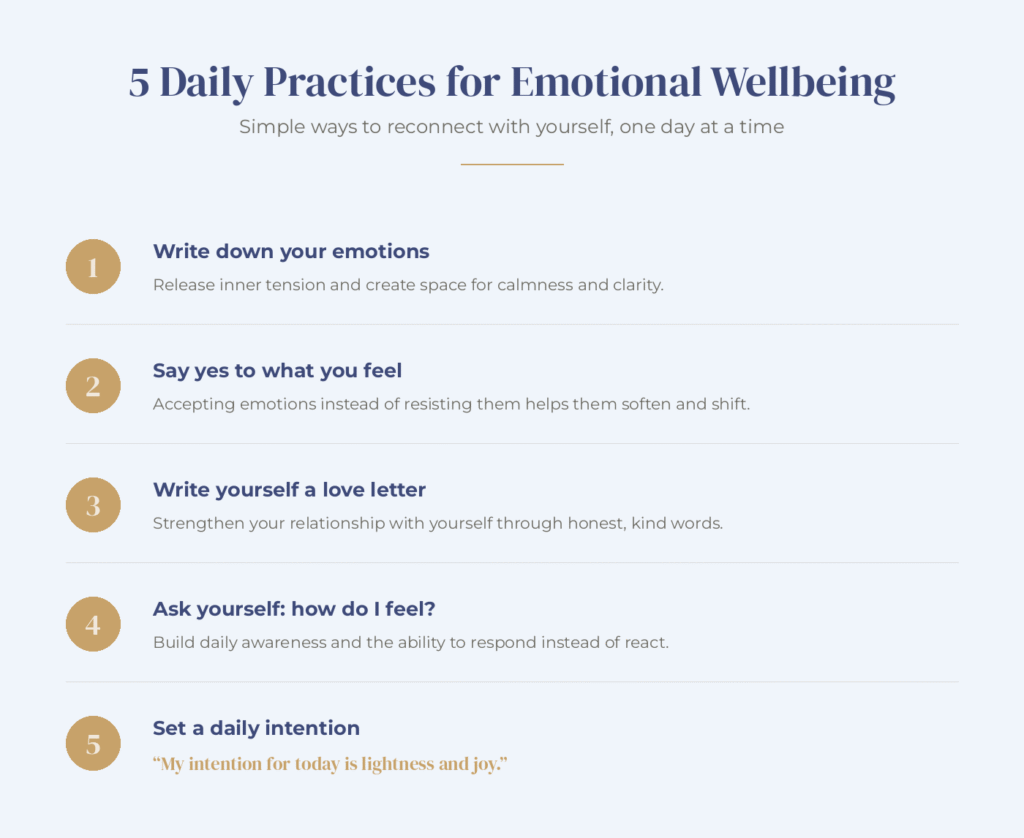
You don’t need to do everything at once. Even one of these daily practices can create a meaningful shift in your emotional wellbeing. Supporting yourself is a choice. One that asks for your presence, honesty, and kindness. It asks for very little, yet gives back so much.
Something deeper may be calling
These practices work beautifully as daily maintenance. But if you find that despite consistent effort something still feels stuck, that’s not a sign the practices have failed. It’s a sign there may be a layer worth exploring beneath the surface.
Continue reading: how subconscious patterns form: why you keep repeating the same cycles? or 5 phases of inner growth. Wondering what energetic reprogramming can do for you? find out here.