
Real Experiences
10-Day Vipassana Meditation Retreat: My Experience & Tips
By Aurelija Aspen | October 18, 2026
On 2 July 2023, I completed a 10-day Vipassana course in Cambodia. When people asked me how I felt afterwards, I felt glad to be out in the world again.
That doesn’t mean the course was a negative experience. Quite the opposite. It was a deeply enriching experience, and I felt grateful for what I had received: a meditation practice I could continue using as a tool for my own growth. After spending ten days focused primarily on my inner world, I was ready to return to everyday life and rediscover the balance between its spiritual and physical sides.
In this article, I share what the course was like for me, how I prepared my body and mind, what I packed, and what stayed with me after I left. If you are thinking about attending your first 10-day Vipassana course, I hope my experience helps you understand what to expect.
What Is Vipassana Meditation?
Vipassana is a meditation technique that goes back to the Buddha, who lived around 2,500 years ago. During the course, I learned about the history of the technique and how it was preserved in Burma. Today, 10-day residential courses are taught around the world in the tradition of S. N. Goenka. You can check whether a course is available near you, so you may not need to travel far.
The practice is based on understanding the impermanent nature of things. We learn to observe bodily sensations without reacting to them with craving or aversion. Instead of immediately judging an experience as pleasant or unpleasant, the practice is to observe it with an equanimous mind.
The course has a clear structure. During the first three days, you practise observing your breath to develop concentration. On day four, Vipassana meditation itself is introduced. On day ten, you learn the loving-kindness meditation known as mettā, and the silence ends. The course finishes on the morning of day eleven.
There is also a code of discipline to follow. It includes five precepts: no killing, stealing, sexual activity, lying, or intoxicants. During the course, you observe Noble Silence, which means no talking with fellow participants, no phones, and no reading or writing. You can speak with the teacher about your meditation practice and with volunteers about practical matters.
You can find information about courses, centres, and the Code of Discipline on the official Vipassana website.
Is a 10-Day Vipassana Course Difficult?
For me, it wasn’t as difficult as I had expected. I didn’t experience moments of crisis or unbearable pain. I had prepared both my body and mind, and I had a clear intention for taking the course. Of course, not everyone has the same experience.
Around 100 people joined the same Vipassana course as me, roughly 60 women and 40 men. Up until day six, I noticed more empty cushions in the main meditation hall each morning. Around 10 participants did not complete the course.
Keeping silent wasn’t particularly difficult for me either. Every second day, the teacher spoke with us individually about our practice to check that we were following the instructions. On day ten, after the morning meditation, we were allowed to talk. Only then did I learn how differently people had experienced the same course.
Among the five foreign women who completed it, the experiences were very different. One described it as feeling like being in prison, another compared it to being in a psychiatric hospital, and I felt as if I had been on a holiday retreat. We had followed the same schedule and practised in the same place, yet our experiences were nothing alike.
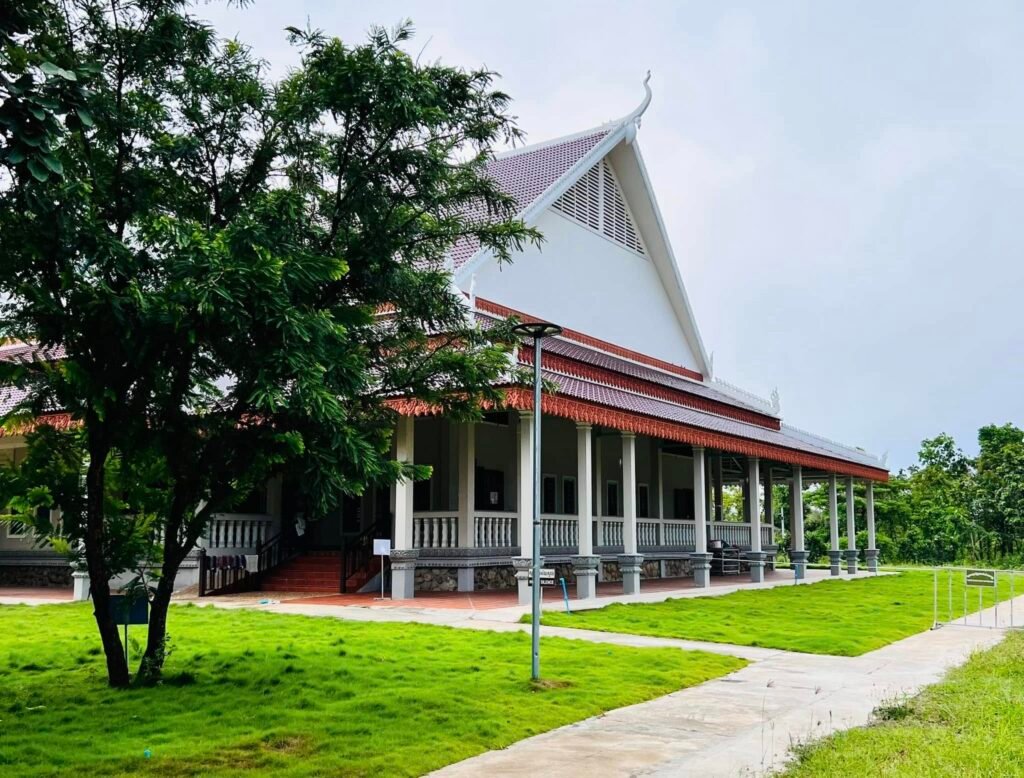
The Dhamma Hall, the main meditation hall at Dhamma Kamboja, where all the group meditations took place.
Why It Felt Like a Holiday Retreat
Before going, I had watched YouTube videos about Vipassana in Cambodia and listened to stories from people who had attended courses. I expected basic conditions and was prepared to share a room with five or six people and use a shared bathroom. On top of that, I somehow thought I would be starving for ten days.
Without knowing much about the centre beforehand, I ended up at Dhamma Kamboja in Roluos Village, around 112 km from Phnom Penh. I was pleasantly surprised by the facilities. Everyone had a private room with a bathroom, and the sanitary conditions were good. The vegetarian meals, served three times a day, were delicious.
What I appreciated most, though, was the simplicity of the days. There was nothing to organise, nowhere to go, and no need to think about everyday responsibilities. I could meditate, eat, rest, and sleep.
Several times, I caught myself thinking how luxurious it was to have ten days entirely to myself. In everyday life, even when we have free time, there is usually something competing for our attention. Here, there was very little to distract me from my practice: no phone, no books, not even a pen to write or draw with, and no one to talk to, just my body, my mind, my feelings, and my senses.
Vipassana Arrival Day (Day 0) and Registration
The course has an arrival day, often called day zero. You register in the afternoon, within the arrival window specified by your centre. In my case, the whole experience, from arrival to departure, lasted twelve days.
The practical arrangements are taken care of that day. You receive your room and your assigned place in the meditation hall. During group sittings, you keep the same seat throughout the course, so you cannot simply move to another place when you feel like it.
That evening, before the course officially began, we had our first short experience of sitting together in the hall. It was a small introduction to the routine that would shape the following days.
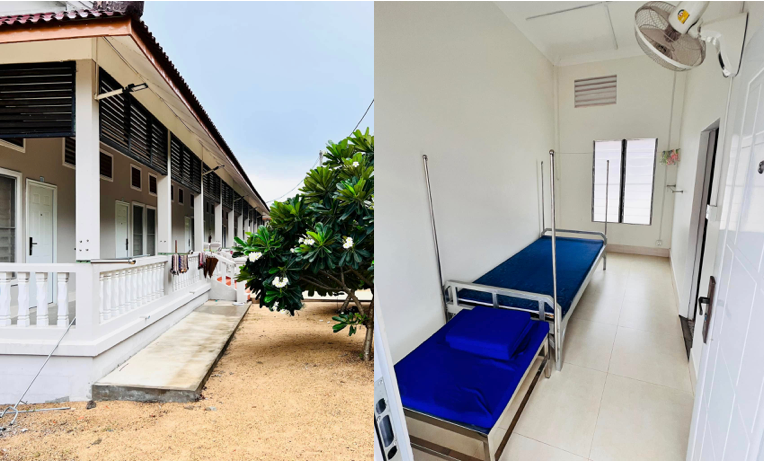
The private rooms at Dhamma Kamboja (left) and the room where I stayed for 12 days (right)
A Typical Day at a 10-Day Vipassana Course
The timetable is intense. You wake up early and spend most of the day meditating, with breaks for meals and rest.
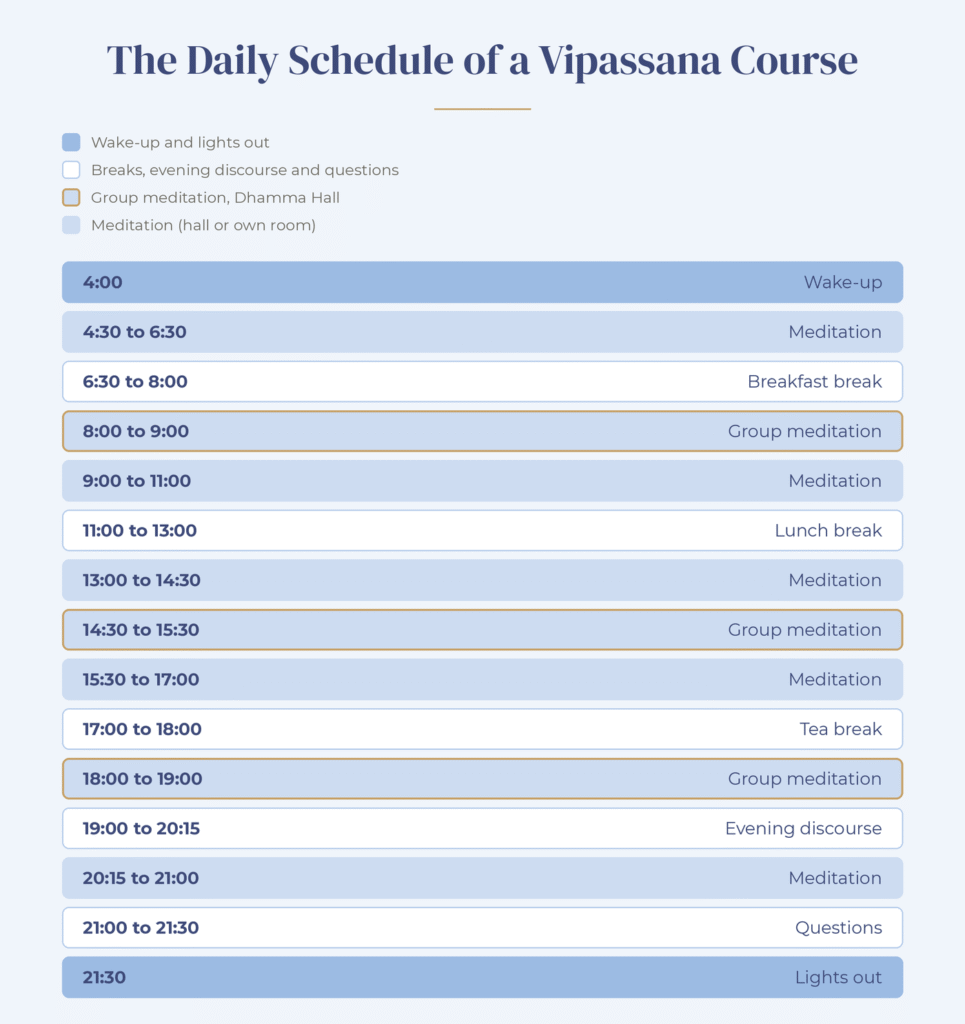
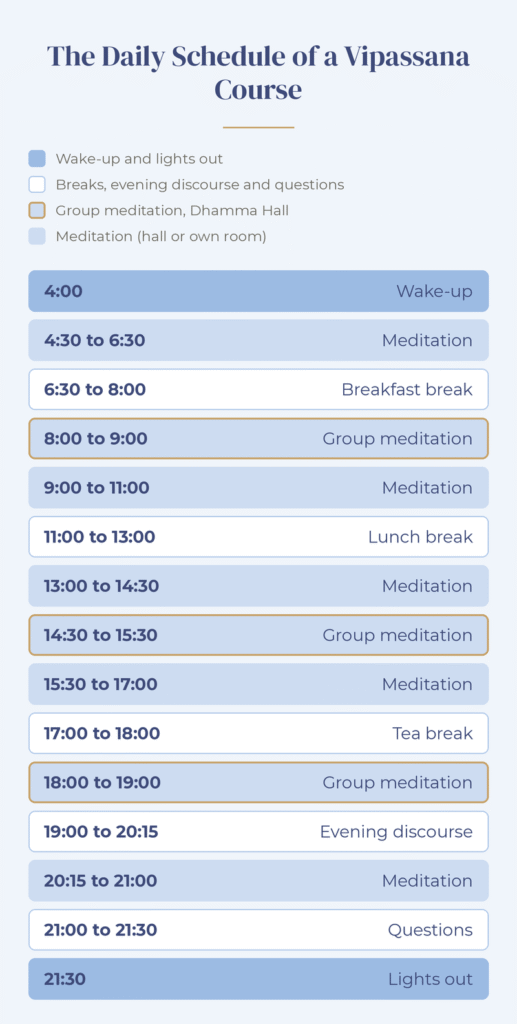
There are several meditation periods throughout the day, as well as the evening discourse. Depending on the session, you may sit for anything from around 45 minutes to two hours.
In Cambodia, the sound of a large gong woke us at four in the morning. At the three-day course I later attended in Lithuania, the wake-up call came through a speaker. I had a simple wristwatch that helped me keep track of time during the day, so I would definitely recommend bringing one.
The group meditations take place in the main hall, known as the Dhamma Hall, and attendance is required. For the other meditation periods, I could choose between the hall and my room. I valued having my own space, so whenever the rules allowed it, I meditated in my room and went to the hall for the group sittings. I heard that some women who stayed in their rooms to meditate were called by the teacher and asked to join the hall. That never happened to me.
Chanting and the evening discourses are also part of the course. We listened to recordings of S. N. Goenka chanting, and his evening talks were mandatory.
The timetable can look intimidating when you first see it. What helped me was not thinking too much about the entire ten days at once, but simply following the schedule and focusing on one step at a time.
How to Prepare for Your First Vipassana Retreat
Before going, I would recommend thinking about what your intention is for taking this course.
My intention was to develop a deeper connection with the higher realms and with my body. Having that intention clear in my mind helped me stay focused throughout the ten days.
Before going to the course, I still had a few months to prepare. I checked whether I could sit in a meditation pose without moving for thirty minutes, but my legs went numb after just five minutes. I did not want to force my body through that, so I ordered a meditation bench, and it was a game changer. I practised sitting meditation at home for thirty minutes every day, then gradually increased the duration to an hour. By the time the course began, I was also doing one-hour sessions twice a day. I used my meditation bench during both Vipassana courses.
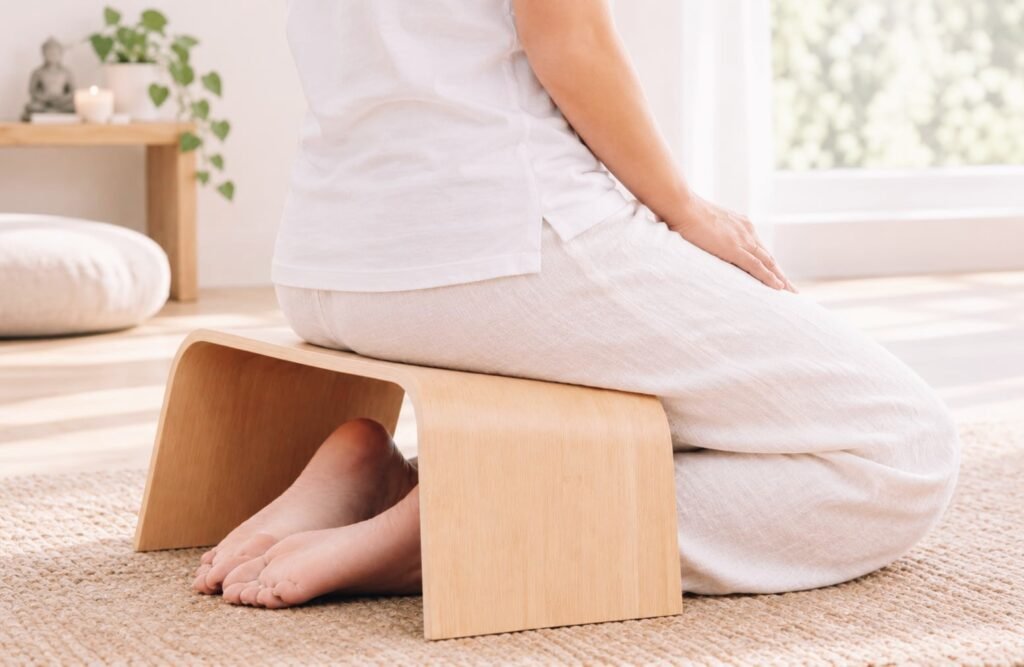
A meditation bench like this one made long hours of sitting much more comfortable.
Because sitting upright for so much of the day puts a strain on your back, I also paid attention to my back muscles. I was already practising yoga, and I added a plank to my daily routine, holding it for several minutes a few times a day. This was what worked for me.
Another useful tip came from a friend who had attended Vipassana several times. She suggested bringing a hot water bottle, the kind you fill with hot water. I used it during breaks and before going to sleep to warm my muscles, which were sore from sitting for long hours in one position.
For me, the important thing was that preparing for meditation didn’t mean ignoring my body. I wanted to practise with commitment, but I didn’t believe that reaching inner peace required my body to suffer.
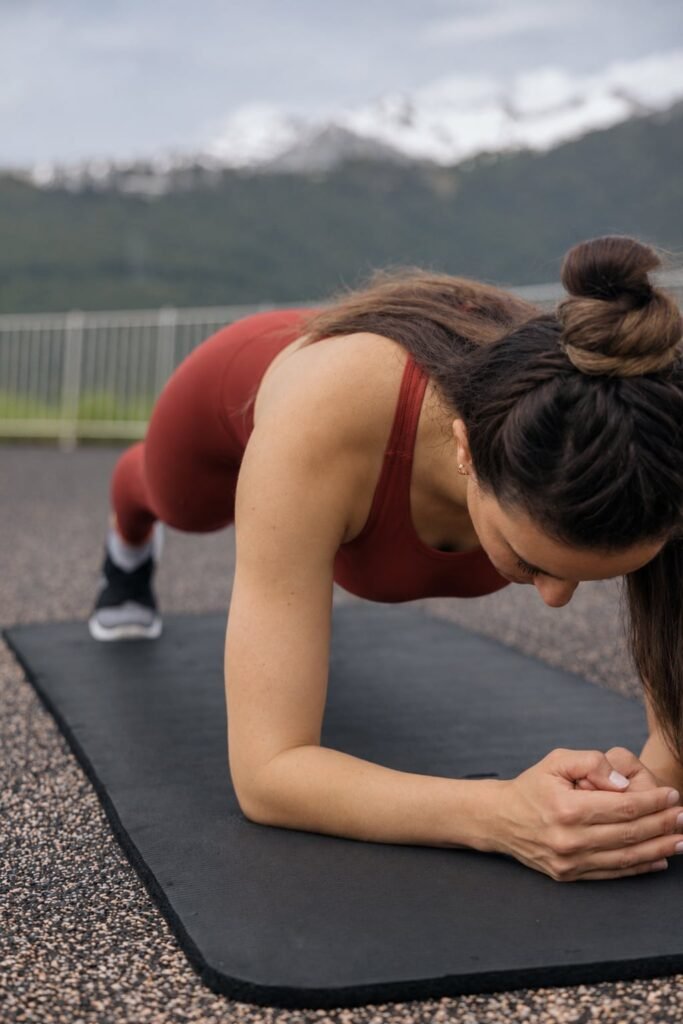
A plank can help prepare your body for long hours of sitting upright.
What to Pack for a Vipassana Retreat
Packing lists differ between centres, so always check the instructions for your particular course. These are the things that made a difference to me.
-
> Modest Clothing
Participants are asked to dress modestly, with knees and shoulders covered and nothing revealing. The dress code at the centre in Cambodia was quite strict. At one point, I was asked to wear leggings under my long dress because my knees became visible when I moved. Women who had attended courses elsewhere told me that the rules there were more relaxed. Choose clothes that are comfortable to sit in for long hours: warm layers in a cold climate, and light, breathable fabrics in the tropics. Most people at the centre in Cambodia, including me, wore white. I found it easier to concentrate in white clothes.
-
> Bedding, Towels and a Cup
Some centres ask participants to bring their own bedding, while others do not. In Cambodia, I was very glad to have brought a sheet, a pillowcase and a blanket cover. The room felt clean, fresh and like home. A towel and a thermos cup for use in the room are also useful. Bring one extra towel for your dishes. In Cambodia, everyone washed their dishes after each meal and took them back to their rooms, so a towel to dry them was a real help.
-
> Hygiene and Unscented Toiletries
Pack toilet paper and all the hygiene products you need, as toilet paper was not available at the centre in Cambodia. Leave perfume at home. Sensory details can intensify during meditation, so unscented products are kinder to you and to other meditators.
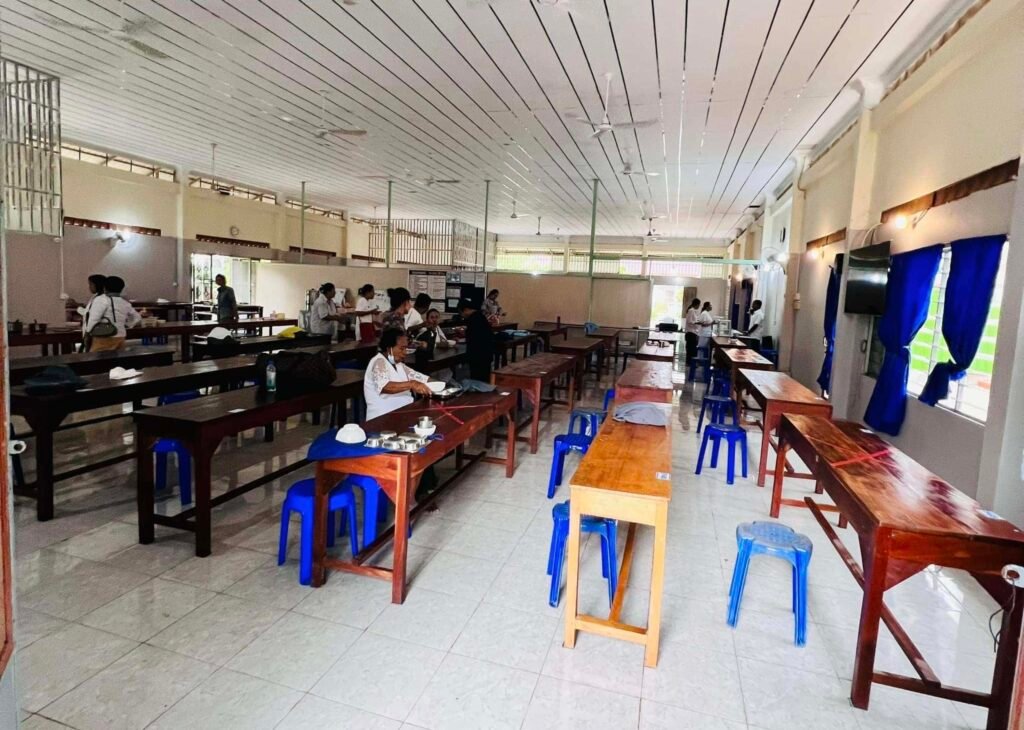
In the canteen, seating is arranged so that you see the backs of other people in front of you, which helps avoid eye contact during meals.
What It Feels Like to Meditate for 10 Days
Each group meditation in the hall begins with a recorded instruction from S. N. Goenka. Five or ten minutes before the end of the sitting, you hear another recording. When you hear it, you know the session is almost over and that only a few more minutes of sitting remain. Sometimes my reaction was “finally!”, and other times it was “ohhh,” because I wanted to sit longer.
The first three days were the most challenging when it came to sitting still. My body was adapting, and my mind was learning to focus more. We spent those days training our attention by observing the air flowing through our nostrils, just below the nose and above the upper lip.
From day four, when Vipassana itself was introduced, I noticed a shift in my body. The soreness in my legs and buttocks gradually gave way to a feeling of lightness. It was great!
During breaks, I often fell asleep within minutes. Even a fifteen-minute nap could bring vivid dreams. I interpreted this as a sign that something was happening internally, as if my subconscious were working through things while I rested.
On day six, I felt a strong urge to sing. I hadn’t realised how much I would miss such an ordinary form of expression until I had gone without it for several days.
What It Felt Like After the Retreat
On the flight back to Ho Chi Minh City, where I lived at the time, I had a very strong feeling that two years of my life had passed, even though I had spent only two weeks in Cambodia. The sensation was so intense that I felt the need to check the date. It felt as if ten days had done the work of two years of processing and releasing.
The first day after leaving the Vipassana course, I went for a walk in Phnom Penh, and my senses felt wide open. At sunset, I watched a father playing with his young son near a fountain. I found myself observing their connection. It felt as if they were creating energetic memories, as though something of their harmonious connection was being imprinted on the energy around them. It felt sacred to witness.
Because I joined the Vipassana course already feeling balanced and at peace, I didn’t notice a dramatic shift in my emotional state. For me, the experience wasn’t so much about emotional or physical healing as it was about deepening my awareness. My awareness and patience grew, and I learned to listen to my body more deeply.
One thing I noticed when I returned home was that, despite eating well and having three vegetarian meals a day, I had lost a few kilograms and was noticeably thinner. This surprised me, since I hadn’t been depriving myself of food.
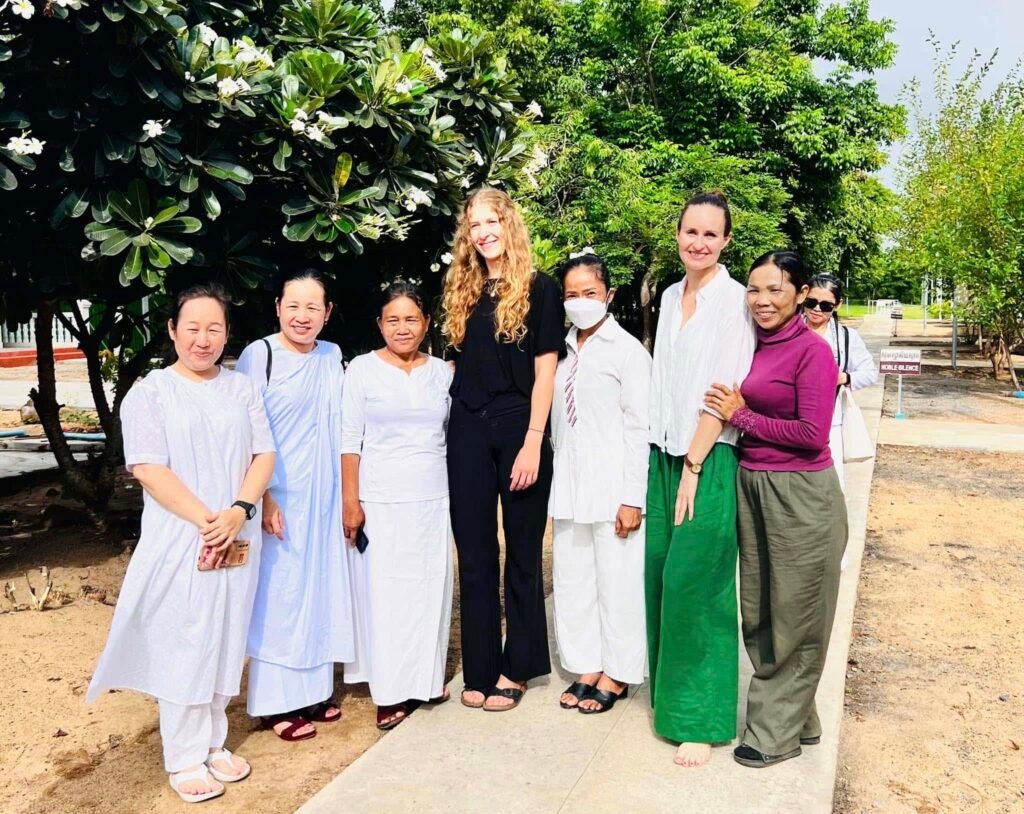
With fellow participants at Dhamma Kamboja, after the silence ended.
3-Day Vipassana Course in Lithuania: My Second Retreat
In 2025, I attended a three-day Vipassana course in Lithuania, my homeland. These shorter courses are available to people who have already completed a ten-day course.
The experience was slightly different from the one in Cambodia. In Lithuania, people were allowed to talk on the day of arrival, whereas in Cambodia, silence began as soon as I arrived and registered.
My senses felt heightened again. I noticed tastes and small details very intensely.
As a returning student, I was not allowed to eat after midday, so I had only breakfast and lunch. During almost every break, I fell asleep and had vivid dreams, as I had in Cambodia.
The two courses reminded me that even when the meditation technique is the same, the place, the people and the intention make each Vipassana experience different.
Meditation as a Way of Paying Attention to Your Body
For me, meditation is a way of connecting with the energy flowing through the body. It helps to pay attention to what is happening inside, to become more aware of yourself beyond what usually shows, and to show attention and love for the body.
When I feel my body is asking for attention, I sit and meditate. It feels great afterwards: clean, pure and refreshed. I am really grateful for the tool of meditation I received during a Vipassana retreat.
If you are wondering whether this kind of meditation is for you, I encourage you to experience it yourself. Prepare well, so that adapting is easier, and make it happen.
Frequently Asked Questions
How Much Does a Vipassana Course Cost?
In the tradition of S. N. Goenka, courses are run entirely on donations. At the end of the course, students are invited to donate towards food, accommodation, and course facilitation, helping to keep the centers running and make it possible for future students to learn Vipassana meditation as well. The amount is voluntary.
Are There Shorter Vipassana Courses?
Yes. After completing a ten-day course, returning students can attend shorter courses, including three-day courses.
Can I Leave a Vipassana Retreat Early?
A ten-day Vipassana course is designed to be completed in full. When you apply, you are asked to commit to following the schedule and staying for the entire course. In my experience, some people did leave before the course ended. Although participants are encouraged to complete the course, circumstances can arise in which someone feels unable to continue. If you experience severe emotional distress or feel that you cannot safely continue, speak to the teacher or course management rather than struggling alone.
Why Do People Quit Vipassana Retreats?
I can only speak from my own observations and what I heard from other participants. My impression is that the intensity of the experience can be one reason people leave.
When you spend several days in silence, with few distractions and many hours devoted to meditation, you may become more aware of thoughts and emotions that are usually easier to avoid in everyday life. You may also experience physical discomfort until your body adapts to sitting for long periods.
Is Vipassana Meditation Religious? Will It Conflict with My Beliefs?
I wouldn’t describe my personal experience of Vipassana as religious. I was baptised Catholic, although I don’t practise Catholicism, and I’m open to learning about different spiritual traditions. The Vipassana technique taught in the tradition of S. N. Goenka has its roots in Buddhist teachings, and the course includes elements of that tradition. However, the practice focuses on observing your own experience through meditation rather than asking you to adopt a new religious identity.
Can I Do Vipassana if I Have a Physical Disability?
During the retreat, I noticed that some participants had injuries or physical limitations. They were able to meditate without sitting on the floor, and older participants also used chairs.
Would I Recommend a Vipassana Course?
Yes, I would recommend considering it if you are interested in learning this meditation technique and are willing to follow the instructions and the course discipline. There is chanting and theory as well as meditation, but I focused on the practice and my own experience. For me, having dedicated time and space held for me, where I could focus completely on my inner world and my body, was very valuable. I am deeply grateful for this opportunity.